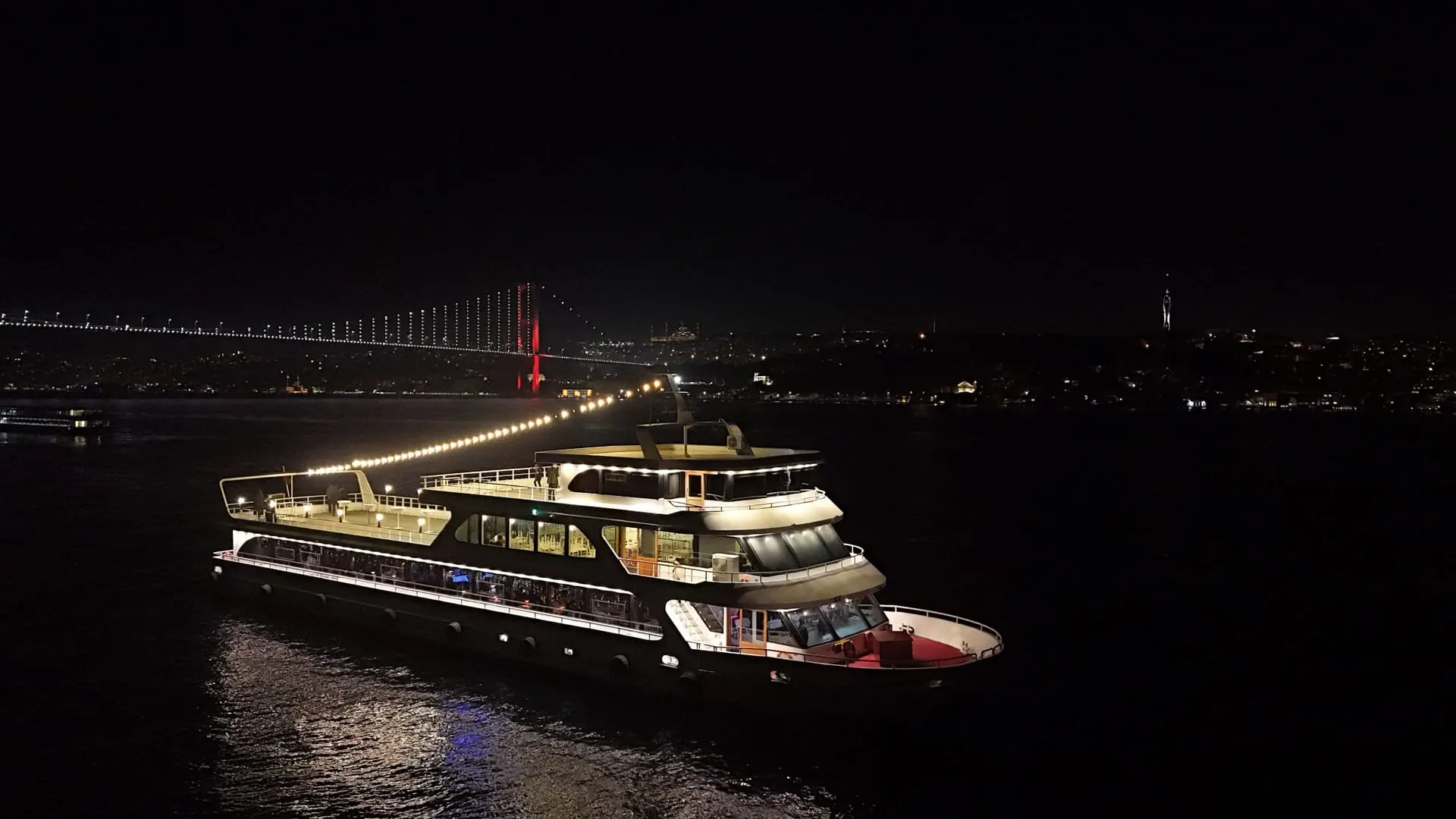
Istanbul has two faces. The daytime city is famous — the queues at Hagia Sophia, the ferries crossing in sunlight, the shouted prices in the Bazaar. The night-time city is quieter and more composed. The traffic on the strait thins. The palaces switch on. The bridges, three of them, begin their slow colour cycles overhead. What was a busy waterway becomes something closer to a stage set, dressed by uplighting and reflected on water that has gone glassy. This guide is for travellers who want to look at that second city properly — what to look at, where to stand, and the route the cruise takes through all of it.
The Bosphorus is a different place after dark
The shift happens at the same moment every evening, and it is sharper than you expect. The last ferries cross around eight. The commercial wharves at Karaköy and Eminönü empty. The colour of the water goes from grey-green to black, and the city's own light becomes the only light — sodium along the shore road, the gilded uplighting on the Ottoman palaces, the LED programming on the three suspension bridges. The monuments stop competing with the sun and start composing themselves against it.
The other change is acoustic. A daytime cruise hears engine noise and ferry horns; a night cruise hears the wash on the hull, the wind across the open deck and, if the moment is right, the distant call to prayer from Ortaköy or Üsküdar carrying across the water. The city sounds different from the strait at this hour.
The bridges as a slow-moving light show
Three suspension bridges cross the strait, each from a different era of Turkish engineering.
The Bosphorus Bridge — 1973
Officially the 15 July Martyrs Bridge, but no one calls it that in conversation. The first crossing built between Europe and Asia, between Ortaköy on the European side and Beylerbeyi on the Asian. It is the bridge in every Istanbul postcard. Its LED system runs the full RGB palette in slow transitions on ordinary evenings; on national days it holds Turkish red and white, on World Diabetes Day blue, on breast-cancer awareness pink. The transition under it from a cruise vessel — perhaps twenty-five minutes after departure — is the photograph everyone takes.
The Fatih Sultan Mehmet Bridge — 1988
The second crossing, two kilometres north, between the historic Rumeli Hisarı fortress and the wooded Asian shore. Less famous, more dramatic — the bridge is taller and the cliffs on either side closer, so passing under it feels closer to threading a needle. The lighting is comparable to the first bridge but the framing, with the floodlit fortress on the European bank, is the better composition.
The Yavuz Sultan Selim Bridge — 2016
The third bridge sits far to the north, beyond the Black Sea mouth, and carries motorway traffic and the high-speed rail line. The standard cruise route does not pass under it; you see it as a distant lit silhouette from the upper deck. Worth knowing it is there.
Palaces lit from within
The Ottoman empire's last great houses were built to be seen from the sea. By day they are tourist sites with ticketed entrances; by night they become uplit facades along the strait, framed by their gardens, with the warm light spilling from their windows. They appear in this order on a northbound run.
Dolmabahçe Palace on the European shore is the most theatrical of the three. The 600-metre baroque facade, the gate towers, the clock tower — all uplit in warm gold. The crystal chandelier in the ballroom is visible through the high windows on the right nights. It is the only palace where the lighting itself feels designed for the view from the water.
Çırağan Palace, a few minutes north, is now a Kempinski hotel. The lighting is more restrained — uplighters on the marble facade, soft warm spill from the restaurant and ballroom — but the building is reflected almost continuously on the water in calm weather. The waterside terrace, lit with candles, is often visible from the cruise.
Beylerbeyi Palace sits on the opposite shore, beneath the Asian foot of the Bosphorus Bridge. Smaller than its European counterparts and lit more sparingly, its white marble takes the colour of the bridge LEDs above it — turning blue, red, pink as the programme cycles. The effect is unintentional and quite beautiful.
The palaces are lit every night until roughly 23:30, then most of the architectural lighting steps down to a lower level. The cruise window — 21:00 to midnight — catches them at their fullest. If you are viewing from land, the same window applies; arrive after eleven and you have missed the best of it.
Mosques reflected on the water
The mosques are the other half of the night composition. Their domes and minarets are lit white by floodlight; the minarets carry a ring of small lamps about two-thirds of the way up, originally hung for Ramadan and now a permanent fixture. On the water they read as vertical strokes of light reflected downwards into black.
Ortaköy Mosque — properly the Büyük Mecidiye Camii, 1856 — sits directly on the water at the European foot of the Bosphorus Bridge. Its small dome and twin minarets are reflected on the strait in calm weather. Passing it from the boat, perhaps thirty minutes into the cruise, is the moment travellers describe afterwards as the one they remember.
The New Mosque (Yeni Cami, 1665) at Eminönü is the first floodlit silhouette you see as the boat departs and the last on return. It frames the entrance to the Golden Horn behind it. Further off, the minarets of the Süleymaniye and the Blue Mosque are visible on the historic peninsula as distant lit points — small, but a register of how far the Old City sits from the strait.
The Maiden's Tower at night
Of all the monuments on the strait, the Kız Kulesi — the Maiden's Tower — is the one that benefits most from the dark. By day it is a small white building on a small island, dwarfed by the city behind it. By night it becomes what it should always be: a single lit silhouette in open water at the mouth of the strait, reflected on the surface, isolated from the city's noise. The cruise passes it twice, once on the outbound leg and once on return; both passes are worth being on the upper deck for.
Best viewing points — water and land
The view from the strait is one thing. There are good night views from land as well; for travellers who cannot do both, here are the considered options.
From the water
The dinner cruise from Eminönü is the obvious answer — three hours, the full route, dinner and music while you move. The other option is a private charter, which the cruise operates on request for groups of twelve and above and which allows you to choose the route and the pace.
From land — the European side
Galata Bridge, with its lower-deck fish restaurants, gives you the upstream silhouette of the New Mosque and the entrance to the Golden Horn at night. The rooftop of the Marmara Pera (the Mikla bar) gives the cleanest aerial view of the historic peninsula. The Çırağan Palace terrace looks directly at Beylerbeyi across the strait, with the Bosphorus Bridge lit overhead.
From land — the Asian side
The Üsküdar waterfront, twenty minutes by ferry, gives you the long European skyline from the historic peninsula to Dolmabahçe in a single sweep. Çamlıca Hill, the highest point on the Asian side, has the best wide view in the city — full panorama from the Black Sea mouth to the Marmara, with both Bosphorus bridges in frame. The rooftop of the Sumahan on the Water hotel, further north on the Asian shore, is the connoisseur's choice.
How the cruise route passes them all
A three-hour evening on the strait is, in effect, a slow edit of the city. The route runs:
- Eminönü — boarding at 20:00, departure at 21:00. The New Mosque lit on the shore behind you.
- Karaköy and the Galata Tower silhouette on the European bank.
- Dolmabahçe — the long baroque facade fully uplit, perhaps fifteen minutes in.
- Çırağan — the hotel-palace, candlelit terrace visible from the boat.
- Ortaköy Mosque and the approach to the Bosphorus Bridge — the night's signature moment, around twenty-five minutes after departure.
- Bebek, the upmarket promenade with its lit restaurants along the shore.
- Rumeli Fortress, floodlit on the European bank, framing the approach to the second bridge.
- The FSM Bridge — the second crossing, the boat's turn point.
- Beylerbeyi Palace on the Asian shore, returning south.
- Üsküdar waterfront, the European skyline now reversed.
- The Maiden's Tower — the lit silhouette at the mouth.
- Eminönü — return around midnight, the city by then quiet.
The whole route is a three-hour edit of what the city looks at itself across the strait. The dinner, the music and the dance floor are the rhythm; the view is the work.
The strait, at the right hour
21:00 departure from Eminönü, back around midnight. Standard and VIP packages, pay on the boat, free cancellation up to two hours before sailing.
Reserve Your Evening →