Istanbul has a particular trick it plays in the last hour of daylight. The sun, by then low over the European hills behind Topkapı, throws horizontal light across the strait and the buildings turn briefly into something else: the white marble of Dolmabahçe glows amber, the soft cream of Çırağan deepens to old gold, the windows of Üsküdar across the water flash for a few minutes as if every flat were on fire. Then the sun drops behind the ridge, the colour leaks out of the stone, and the city quietens into its evening register. This narrow window — call it the catching fire — is what people mean when they talk about a Bosphorus sunset.
The forty-minute window
It is worth being clear about what we are talking about. Sunset is not a long event. The technical golden hour — the warm, low, slanting light that flatters everything it touches — lasts roughly thirty to forty-five minutes before the sun touches the horizon. After that, the sky has another forty minutes or so of colour while the sun is already below the ridge: pinks, then violets, then the deep cobalt of the blue hour. By the time full night arrives, you have spent about an hour and a half watching the light move through its phases. On the Bosphorus, where the geography orients almost north-south and the boat is constantly turning, those ninety minutes feel longer; you keep getting new compositions.
What you cannot do is treat it as background. If the sunset matters to you, plan around it.
What golden hour does to the palaces
The two buildings worth watching as the light goes are Dolmabahçe and Çırağan, both on the European bank within twenty minutes of one another.
Dolmabahçe is the larger and more theatrical. Built in the 1850s as the late-Ottoman answer to Versailles, its facade is white marble laid flat against the water for almost six hundred metres. In midday sun the marble is plain and almost flat; at golden hour it lights from within. The carvings throw shadows that hadn't been there an hour earlier. The clock tower at the gate catches the sun first, then the long colonnade, then the imperial gate at the end of the building turns the colour of late honey. It is the single most photographed minute of the European shore.
Çırağan, a few minutes further north, is now a hotel but was originally a sultan's palace; its stone is warmer, more cream than white, and the effect of low light is gentler — less drama, more glow. Behind it, the wooded slope of Yıldız Park darkens to a deep green, and the contrast between the lit facade and the shaded hill is one of the quieter pleasures of the route.
The water turns first
If you watch carefully, you will notice that the surface of the strait changes before the buildings do. The Bosphorus current is fast — two layers, the surface running south and a counter-current deeper down running north — and the water is rarely still. When the western sky begins to colour, the strait catches it back in fragments: a hundred small mirrors, all moving, all gold for a moment and then black again as the wave tilts. From the upper deck of the boat this is mesmerising. It is also where the postcard photographs come from. Foreground water lit, palaces glowing in the middle distance, hills going to silhouette behind. The image holds for perhaps ten minutes.
When sunset falls month by month
The single most useful thing to know before you book is what time the sun actually sets on the date of your visit. Istanbul sits at 41° north, which means the swing across the year is wide — wider than most Mediterranean cities, narrower than London. In rough numbers:
- December–January: sunset around 16:45–17:15. Full dark by 18:00. Cold, often overcast, but on the clear winter evenings the light is startlingly red.
- March: sunset around 18:30, drifting later through the month. The air starts to feel mild.
- April–May: sunset 19:30 climbing to 20:15. Clear skies become common; this is one of the best windows of the year.
- June–July: sunset 20:30 at the peak, then easing back. Warm, occasionally hazy, but evenings are long.
- August: sunset 20:00 dropping back through the month.
- September–October: sunset 19:30 in early September, 18:30 by late October. The light tends to be clean, the colours saturated.
- November: sunset 17:00. Evenings cool quickly after dark.
For the freshest figure on your travel date, a quick check of a sunrise–sunset table is worth the thirty seconds. The numbers above are a guide, not a guarantee.
Sunset cruise vs evening dinner cruise
This is the honest part of the conversation, and it matters because we sell the evening cruise.
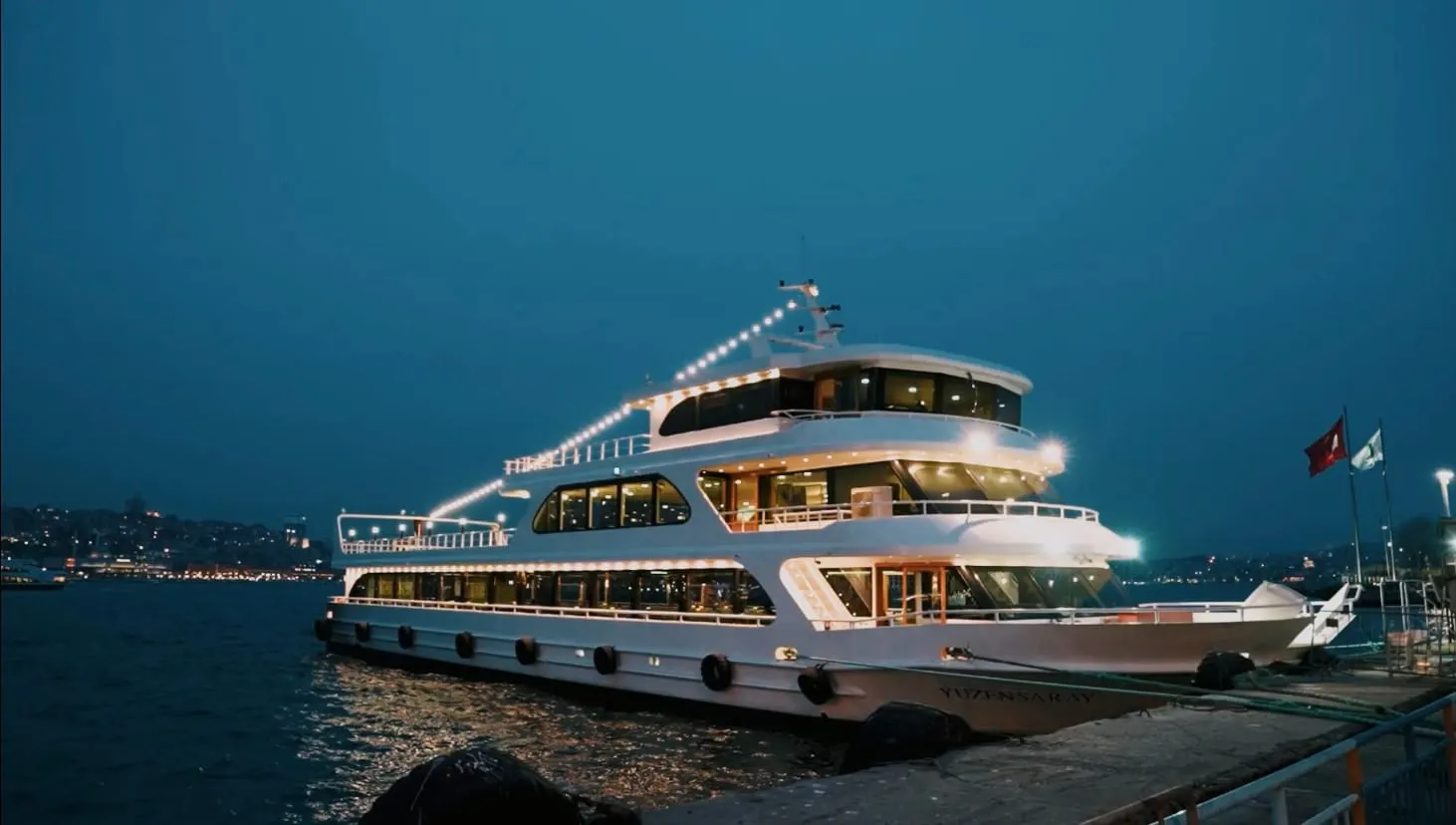
Our dinner cruise departs Eminönü Pier at 21:00, with doors from 20:00. In midsummer (late June, July) the last warm light is still on the water as you board, and the upper deck catches a memorable few minutes before dinner begins. In late August through April, the sun has already set by departure — what you experience is the blue hour fading into full night, with the city's lights coming up along both shores. That is its own thing, and arguably the more dramatic image: lit Ortaköy Mosque against the blue, the suspension bridge above it strung with light, the palaces uplit from the water.
If the sunset itself is the priority — the actual sun going down over the city — a dedicated late-afternoon sightseeing cruise (no dinner, no programme, an hour and a half on the water around the golden hour) is the more honest match outside of June and July. The evening dinner cruise gives you the night version of the strait. Both are beautiful. They are not the same picture.
For photographers — golden and blue hour
A short technical note for the people who pack the wide lens.
During the golden hour, the best frames are wide and horizontal: the long line of Dolmabahçe with hills behind, the curve of the Bosphorus Bridge against the warm western sky, anything that includes both lit stone and lit water. Highlights are warm; shadows are deep blue. Underexpose slightly to keep the sky's colour.
During the blue hour, the city's artificial lights come up to roughly match the brightness of the sky — which is the photographer's favourite condition. Suddenly you have a balanced exposure between a lit mosque and a still-blue heaven. This is when the bridge photographs at its best: the underbody strung with cool white lights, the suspension cables clean against deep cobalt, the boat traffic leaving short red wakes if you can manage a brief handheld exposure. It lasts about twenty minutes. Be ready.
After the blue hour fades, the strait becomes a dark river with bright punctuation marks — beautiful, but the camera struggles unless you stabilise.
Best months to come for the sunset itself
If the sunset is the reason for your trip — if you have flexibility on when to come and the light is the brief you have built the visit around — two windows stand out.
Late April to mid June. The air is reliably clear, the colours are saturated, the temperature on the water is mild and the days are long enough that you can still eat dinner on the boat at 21:00 with the last warm light fading on the western hills. May, in particular, is the quiet peak: clean skies, gentle breezes, comfortable evenings on the upper deck.
Mid September to late October. The summer haze burns off, the sky deepens, and the autumn sun sits at a lower angle that flatters the architecture even more than summer's higher arc. Late September evenings are reliably gold; mid-October sunsets can be extraordinary. Bring a light jacket.
July and August work too, but the heat haze can soften the distance, and the sunset itself sits very close to your boarding time at 21:00, which gives less margin if you want to be settled before the light begins to change.
Whichever month you come in, take the first ten minutes of the cruise on the upper deck rather than at the table. The kitchen will hold the meze, the city is at its most photogenic in those minutes after the boat clears the pier, and the meal will still be there when you come down. You will not regret it.
Boarding from 20:00, departure 21:00, back near midnight
Three-deck vessel from Eminönü Pier. Multi-course dinner, the full Anatolian programme, the dance floor and the upper deck. Free cancellation up to two hours before. Pay on the boat.
Reserve Your Evening →