Most travellers who visit Istanbul will, at some point, look at a Bosphorus dinner cruise. The strait is the city's defining geography; an evening on it is the rare experience that almost everyone agrees was worth the time. The question is rarely whether — it's which one. Prices range from around fifteen euros a head to more than a hundred, and the photographs all look broadly similar. So what actually changes when you upgrade? This is an honest, line-by-line answer, written from the inside.
The route — same strait, different experience
Here is the part that's worth being honest about: the geography does not change. Almost every commercial Bosphorus dinner cruise — luxury or otherwise — follows the same approximate arc. You depart from Eminönü or the Galata side around nine in the evening. You head north along the European bank: Dolmabahçe Palace, Çırağan, the Bosphorus Bridge overhead, Ortaköy Mosque on your left. You turn at the second bridge (the FSM, named for Mehmed the Conqueror) and come back down along the Asian shore — Beylerbeyi Palace, Üsküdar, Maiden's Tower in the distance — to the same pier, around midnight.
What changes between a luxury cruise and a standard one is not the geography. It's the way you experience the geography. From a window-side table on a quiet boat with a multi-course dinner being paced through the evening, the strait is a slow film. From a crowded deck on a stripped-down vessel with the meal already on your plate when you sit down, it is a long bus ride with a soundtrack. Same Bosphorus.
The vessel itself
The single biggest variable, and the one most photographs flatten. Standard cruises tend to operate older, single-deck vessels with bench seating, a limited bar, and a capacity that's been pushed close to the legal limit. Luxury cruises run newer three-deck boats: a main salon for dinner with full panoramic windows, a sky deck for after-dinner drinks and the dance floor, and a semi-open mid-deck for those who want air without being in the wind. The capacity is lower per square metre. There is room around your table.
This is the difference you feel from the moment you board. Not the menu, not the show — the room you're in.
The dinner
Here the gap widens.
On a standard cruise
Dinner tends to be served as a single plate: a portion of grilled chicken or fish with rice and a salad, with a piece of bread, brought out shortly after departure. Soft drinks are usually included; alcohol is extra and priced à la carte. The meal is over within an hour. The remaining two hours are filled with music and dancing.
On a luxury cruise
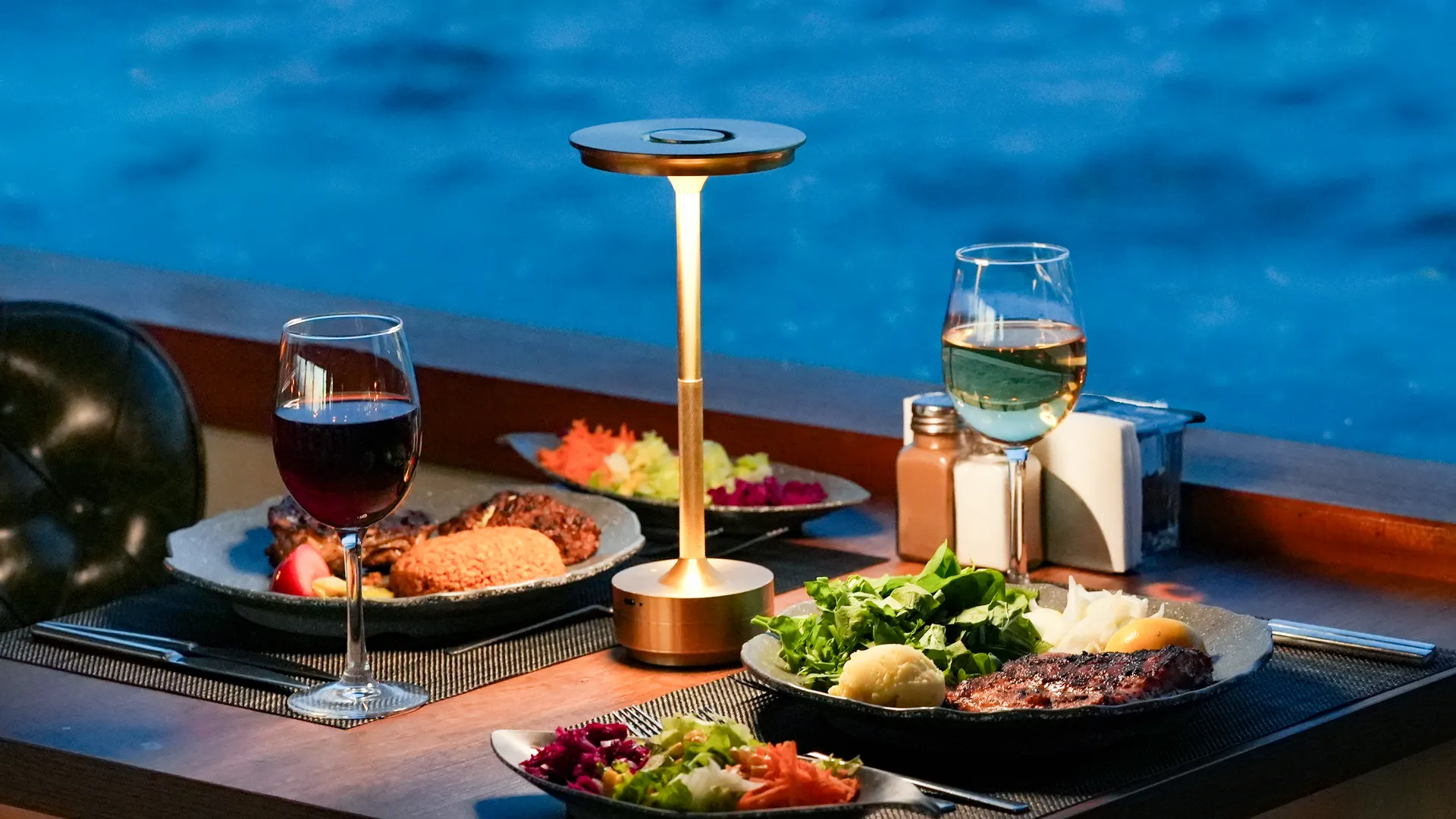
Dinner is a multi-course menu, paced through the evening. The opening is a spread of Turkish meze — usually ten to fifteen small cold dishes (hummus, ezme, fava, smoked aubergine, yoghurts with herbs, marinated vegetables) — meant to be picked at while you settle in. A warm appetiser follows: paçanga böreği, a crisp pastry filled with beef pastırma and kashar cheese, is the standard. Then the main course, served with a seasonal salad. You choose: meatball, grilled chicken, salmon, sea bream, or a vegetarian falafel platter. On the VIP menu the meat selection upgrades to include beef tenderloin and ribeye. Dessert closes the meal.
Soft drinks (water, juice, soda) are unlimited and included. The alcohol package — beer, rakı, gin, vodka, red and white wine, unlimited through the night — is the optional add-on most guests choose. Imported drinks (champagne, whisky, cognac) are available at extra cost. None of this is rushed; the courses are spaced to match the route, so the main arrives as you pass the bridges, dessert as you turn for the Asian shore.
Service & seating
This is the quietest difference, and often the one travellers describe afterwards without naming it.
Standard cruises typically seat guests on shared benches. You sit where you sit. The waiter visits the table once with the food and once with the bill. The room is full and warm.
Luxury cruises give every reservation a private table — two-person, four-person, or longer — and the table is yours for the evening. Service is closer to a hotel restaurant: a server assigned to the area, refills without being asked, menus presented at the table rather than already laid out. The VIP package places those tables near the stage. The Standard package keeps you in the same room with the same kitchen and the same view.
For couples this matters more than the menu. For families with a child who needs a specific dish, it matters even more. The kitchen can handle dietary requests when there's time and a clear table to send them to.
The performance
Both kinds of cruise tend to include a live programme — it is part of the standard form. The difference, again, is execution.
A standard cruise will run a shortened version: one belly dance set, perhaps a Turkish folk number, and recorded music in between. The stage is small. The performers may or may not be the same from one night to the next.
A luxury cruise runs a fuller programme — typically four acts. A whirling dervish opens the evening with a slow, ceremonial set. A drum ensemble follows. Then Anatolian folk dances. Belly dance is the night's peak, placed late in the evening. After the structured programme ends, the DJ takes the upper deck and the dance floor opens — different theme each night of the week (Latin, deep house, vintage 90s, R&B, commercial), but the energy is consistent. Lighting is concert-grade. Sound is balanced for a moving vessel.
What's actually included
This is where the price tags can be misleading. A €15 standard ticket sometimes excludes the dinner entirely, or includes only the soft drink and not the alcohol, or comes with a transfer surcharge added at the pier. A €60-90 luxury package is usually inclusive — dinner, soft drinks, taxes, full programme. Optional add-ons are the alcohol package, hotel transfer (€10/person, both ways), the romantic-table setup (candles, petals, flowers) and, on request, an on-board photographer.
The luxury bill is more predictable. There is less to add on the night.
Is the upgrade worth it
For most travellers, yes — and the reasoning is simpler than the price difference suggests. You are in Istanbul once. The Bosphorus evening is the experience the city is best known for. The strait runs through every postcard, every photograph that came home from this city for a hundred years. To do it cheaply is to compress an evening that the city was built to spread over three hours.
The exception: a long weekend trip with multiple meals already booked at restaurants you've been looking forward to. In that case, a shorter daytime cruise without dinner — sunset, perhaps — gives you the geography without the meal you didn't need.
For everyone else, the luxury upgrade is the version of the evening that the city has in mind.
If you compare prices online, look at what's actually inside the package. A €15 ticket is rarely €15 at the end of the night. A €60 ticket is usually €60 at the end of the night. The difference is mostly the predictability — and the room you spend the evening in.
Three hours, two continents, one Bosphorus
Three-deck vessel, multi-course menu, full Anatolian programme, the dance floor and the upper deck. Free cancellation up to two hours before departure. Pay on the boat.
Reserve Your Evening →