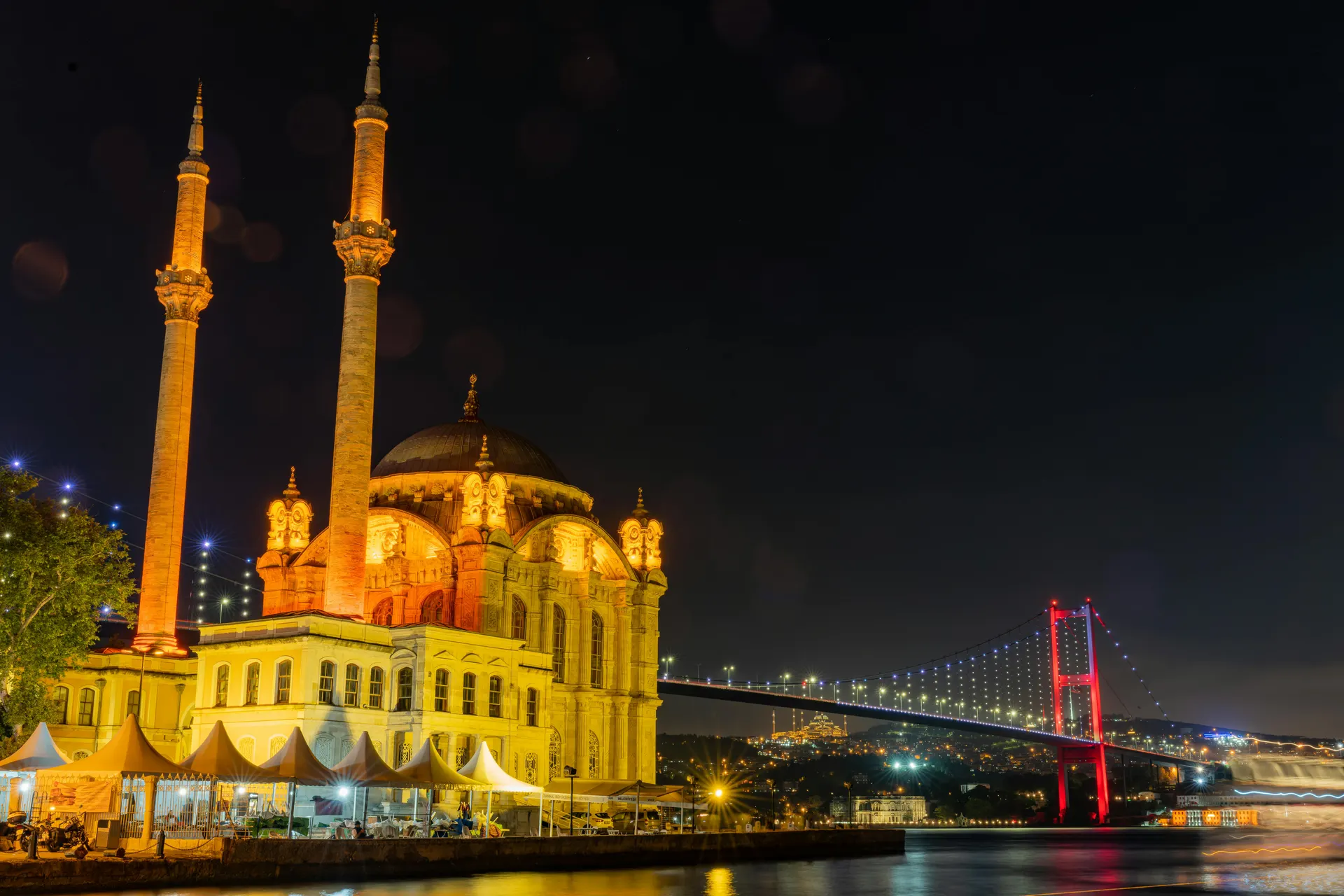
The Bosphorus is one of the most photographed waterways on earth, and yet the best images of it tend to be the patient ones. Twenty minutes of light, two minutes of decision, one frame that keeps the bridges in scale with the mosques behind them. This is a working guide to twelve locations along the strait — where to stand, when the light arrives, what lens to mount. None of it is secret; all of it rewards arriving early.
Why the Bosphorus rewards a patient photographer
Three things, mostly. The light: Istanbul sits at a latitude that gives a long, low golden hour for most of the year, and the strait runs roughly north-south, which means side-light at sunset and side-light again at sunrise — flattering for both façades and faces. The water: a reflective surface a kilometre wide is its own softbox; mosques and palaces along the shore are lit twice. And the layering: minarets in front of bridges in front of distant hills, all in one frame, almost everywhere you point a camera.
The trade-off is haze. Istanbul's summer atmosphere is humid and slightly turbid, especially in July and August. Long-distance shots — Maiden's Tower from across the strait, the second bridge from Bebek — go softer than you expect. The fix is autumn, or early morning before the city warms up.
Twelve spots, south to north
Roughly geographic, beginning at the mouth of the Golden Horn and walking up the European bank, then crossing to the Asian shore for the last three.
1. Galata Bridge, lower deck
Fishermen line the upper deck from morning until late; the lower deck is the photographer's level. Frame the silhouettes of the rods against Yeni Cami across the water, or wait until blue hour and shoot back toward Süleymaniye on the hill. Timing: blue hour, when the bridge lamps flick on and the mosque domes turn deep cyan. Framing: 35mm or 50mm; tighter compositions cut the visual clutter. Gear: small tripod, polariser to cut reflection on the wet stone.
2. Galata Tower — terrace and from below
The terrace at the top gives you a 360° survey: the Old City peninsula to the south, the Golden Horn west, the Bosphorus opening east. The terrace is busy; arrive at opening or in the final hour before close. The view from below — looking up Galip Dede Caddesi as the tower catches the last sun — is easier and often more atmospheric. Timing: top terrace at sunset, base at twilight when the tower itself is lit. Framing: 24mm for the panoramic, 85mm for tight crops on distant minarets.
3. Karaköy waterfront and the Çukurcuma side streets
Below Galata, the Karaköy quay catches the Old City head-on across the Horn. Walk east toward Tophane and the ferries enter the frame. The Çukurcuma streets above — antique shops, faded Greek façades, narrow stairs — are texture work, not vista work. Timing: waterfront at sunrise for the cleanest air; streets in mid-afternoon shade. Framing: 35mm walking lens. Gear: stay handheld; the texture rewards small movements.
4. Dolmabahçe Palace — gates and from the boat
The ornamental gates on the land side are extraordinary but tightly framed. The honest view of Dolmabahçe is from the water, looking back at the long marble façade. From land, walk the seawall toward Beşiktaş for an angled shot that includes the clock tower. Timing: late afternoon; the western façade lights up. Framing: 50mm from the seawall; 24mm from the boat to fit the full elevation. Note: no tripods inside the palace.
5. Ortaköy Mosque from across the bay
The single most photographed building on the strait, and for reason — the marble façade sits directly under the first bridge, two icons in one frame. The standard shot is from the small Ortaköy square at water's edge; the more considered shot is from the Beşiktaş side, fifteen minutes' walk south, where the mosque, bridge and Asian shore stack into three planes. Timing: blue hour. The bridge lights cycle colours; the mosque is lit warm. Framing: 35mm for the wide stack, 85mm to isolate the dome against the bridge cables.
6. Çırağan Palace shoreline
The promenade between Ortaköy and Çırağan runs at water level — palms, the palace pool extending into the strait, slow ferries crossing in the background. Quietly one of the most cinematic kilometres in the city. Timing: the hour before sunset; the limestone glows. Framing: 50mm, low angle.
7. Bebek bay
A crescent of café terraces around a small marina, with wooden yachts moored close to the shore. Bebek is best photographed by people, not at people: shoot the boats against the European hills behind, or the line of cafés lit at night with the strait dark beside them. Timing: early morning for the boats reflected in still water, or 22:00 for the café-light scene. Framing: 35mm for context, 85mm for boat detail.
8. Rumeli Fortress
Mehmed II's hilltop fortress overlooks the narrowest point of the strait. Climb the inner walls for the postcard — towers in foreground, second bridge spanning the strait above, Anadolu Hisarı opposite. Timing: late afternoon; the western light hits the limestone walls. Framing: 24mm to include the bridge sweep. Note: uneven stone steps; bring grippy shoes, not a heavy bag.
9. Anadolu Hisarı (Asian side fortress)
The older, smaller sister fortress on the opposite bank — quieter, less restored, more atmospheric. The small wooden mosque at its foot and the Göksu stream curling behind make a layered frame. Timing: morning, before the boat traffic builds. Framing: 35mm.
10. Üsküdar shoreline — Mihrimah Mosque and the ferry pier
The Mihrimah Sultan Mosque sits right above the Üsküdar pier; the working ferry terminal in front gives you constant foreground motion. Stand on the small pier east of the main terminal for the cleanest line. Timing: sunset; the Old City peninsula across the water lights up behind the ferries. Framing: 50mm; the mosque dome and a ferry in the same frame.
The cleanest, least-crowded sunset shot of the Old City skyline isn't from Galata or Süleymaniye — it's from the Üsküdar ferry deck itself. A one-lira crossing, fifteen minutes long, with the dome of Hagia Sophia rising over the Sultanahmet ridge as you pull away. Sit on the upper deck, starboard side, leaving Üsküdar at golden hour.
11. Maiden's Tower from Salacak
The small tower on its own islet off the Asian shore is the most photographed object in Istanbul after the Blue Mosque. The Salacak promenade, ten minutes' walk south of Üsküdar pier, puts you at the perfect distance — the tower fills a 70mm frame nicely, with the Old City rising behind. Timing: sunset, when the tower is silhouetted against the western glow; or blue hour, when it lights up and the city lights it. Framing: 70mm minimum; the tower is further than it looks.
12. The boat itself — the moving frame
An evening cruise gives you angles unreachable from land: bridge underpasses looking up at the lit cables, the illuminated palaces sliding past at three knots, the wake catching reflected light off the city. The upper deck is the place to be. Timing: the moment of departure (still partial daylight in summer), the bridge pass (about 25 minutes after departure), and the return past Ortaköy (about 90 minutes later). Framing: 24mm for the deck-and-city wide shot, fast 50mm or 35mm prime for low-light handheld. Gear: no tripod — the deck moves. ISO 3200–6400 is normal; embrace it.
The clearest months
October is the photographer's month. The humidity drops, distant bridges sharpen, the light leans warm. Early November is almost as good and tends to be quieter. April runs a close second — clean air, blossoming Judas trees along the strait, longer afternoons than autumn. May and June are bright but the air starts to soften. July and August give you the brightest highlights and the softest distances; close-range work is excellent, long-distance work is hazy. December is sharp, cold and short — the bridges hold light all day, but you have perhaps five hours of working light total.
Equipment, briefly
For a one-bag traveller, three lenses cover almost everything on this list: a wide (16–24mm) for the bridge underpasses and palace façades, a standard (35mm or 50mm) for the working shots, and a short telephoto (70–85mm) for the Maiden's Tower and isolated minaret crops. A polariser earns its place at the waterfront. A small travel tripod earns its place at blue hour. A second battery earns its place because everything photographed at twilight runs the camera harder than you'd think.
What doesn't work: long exposures on the boat (the deck moves), heavy tripods on the fortress walls (the stairs punish you), and ultra-zooms that compromise low-light performance. The strait at night is the test, and a fast prime always wins it.
The view from the upper deck
Three hours on the water, the bridges from below, the palaces lit and sliding past. The upper deck is open throughout the evening. Bring a fast lens.
Reserve Your Evening →