For most of the nineteenth century, the Ottoman court arrived at home by boat. The sultan rode a slim wooden caïque rowed by liveried oarsmen from the Topkapı landings or from one of the smaller palace piers along the strait; foreign ambassadors disembarked at the marble water gates; the empress of France stepped from the imperial yacht onto a red carpet laid across the Beylerbeyi steps. The carriage entrance, where there was one, faced inland to the road; the architectural entrance — the facade the building was built to be looked at — faced the sea. This is the only honest way to read the palaces of the late Ottoman city, and the reason a cruise still gives you something a tour bus cannot.
Why the palaces face the water
The Bosphorus is not a river. It is a strait — twenty miles of fast-moving water connecting the Black Sea to the Marmara, deep enough for naval vessels, narrow enough that the two shores are in constant view of each other. For an empire whose court depended on visible ceremony, this was a perfect stage. A new palace was a statement to be seen at distance, by ambassadors arriving on visiting ships, by Constantinople's merchant ships, by the city itself looking across the strait. Building inland would have wasted the audience.
The practical reasons were the same. Caïques moved faster than carriages through a city whose hills and narrow streets defeated road travel; the water was cooler than the air in summer; and the palaces' gardens, terraced down to private piers, gave the sultan a way to receive visitors and dispatch them again without ever exposing the inland gate. By the mid-nineteenth century the court had effectively abandoned Topkapı, on its hill above the historic peninsula, in favour of the new waterside palaces along the European shore.
Topkapı — the older, hill-top exception
Topkapı Sarayı is older and different. Mehmed the Conqueror began it shortly after the city fell in 1453, and the court lived there for nearly four hundred years. It sits on the high ground of Sarayburnu, above the mouth of the Golden Horn, with the Bosphorus opening out beneath it. It faces inland in the medieval manner — a series of courtyards behind walls, the Harem hidden in the heart of the complex, no grand seaward facade.
From the cruise you see only its retaining wall and the wooded ridge above. To visit, walk it from Sultanahmet in the morning; the Imperial Treasury and the Harem (a separate ticket) are the rooms that justify the time. The point worth holding onto is the comparison: Topkapı belongs to an Islamic-medieval idea of palace architecture; the three waterfront palaces below belong to a European-influenced nineteenth century. The shift between them — over a generation, in the 1840s and 1850s — is the visible record of the empire's last attempt to modernise.
Dolmabahçe — the empire's grand statement
Dolmabahçe Palace was finished in 1856 for Sultan Abdülmecid I, who wanted a residence that argued, to any visiting European, that the Ottoman court was their equal. The architect was Garabet Balyan, of the Armenian dynasty that built nearly every major late-Ottoman building on the strait. The result was the largest palace in Turkey — 285 rooms, 46 halls, 600 metres of frontage on the Bosphorus.
The style is baroque and rococo, in marble and gilt, with the Ottoman vocabulary worked back in: the calligraphic friezes, the Iznik-style tile patterns, the heavy chandelier work. The Ceremonial Hall holds the largest crystal chandelier in the world — four and a half tonnes of Bohemian crystal, gifted by Queen Victoria, hanging from a 36-metre dome. The throne room behind it received foreign ambassadors; the harem section, separated by a long corridor, housed the imperial family.
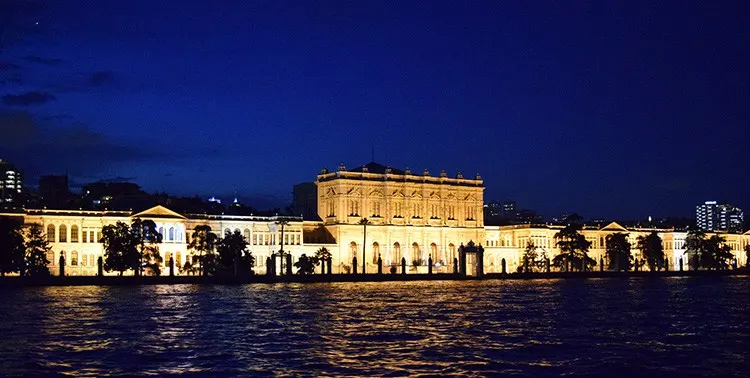
Atatürk used Dolmabahçe as his Istanbul residence in the early years of the Republic and died there on 10 November 1938. Every clock in the palace is stopped at 9:05, the time of his death. From the boat you see the whole length of the seaward facade in a single pass — the symmetry of it, the gate towers at each end, the small marble pavilion at the water gate where the imperial caïque used to dock. By night the entire frontage is uplit in warm gold; in afterglow on a clear evening it is the most theatrical sight on the strait.
Çırağan — the palace you can sleep in
Çırağan Palace, fifteen minutes further north along the same bank, was built between 1863 and 1871 for Sultan Abdülaziz, by Nigoğos Balyan — the son of the Dolmabahçe architect. It is the most restrained of the three: a neo-classical white marble facade with a colonnade, more European than its predecessor, lighter, less encrusted with detail.
The history is brief and unhappy. Abdülaziz was deposed in 1876 and died in the palace days later in circumstances his family disputed. His successor, Murad V, spent twenty-eight years confined there. In 1910 a fire gutted the interior, leaving only the marble walls; the building stood as a ruin for most of the twentieth century. It was restored in the 1980s and 1990s and reopened as the Çırağan Palace Kempinski — the only Ottoman imperial palace in the world that can be slept in. The original palace rooms house the hotel's suites and the Tuğra restaurant; a modern wing was added discreetly to the inland side.
From the water you see the white facade and its colonnaded promenade, the candlelit terrace at the restaurant level, and the small private pier at the water's edge. The hotel has restored the building to something close to what nineteenth-century visitors would have seen arriving by caïque.
Beylerbeyi — the summer palace
Beylerbeyi Palace sits on the Asian shore, directly beneath the Asian foot of the Bosphorus Bridge. It was built in 1865 — again by a Balyan, again for Abdülaziz — as a summer palace and a guest house for visiting foreign royalty. Smaller than its European counterparts, more domestic in scale, with a long terrace stepping down to the water and two small marble pavilions for the bathers.
The most famous guest was Empress Eugénie of France, who stayed in 1869 on her way to open the Suez Canal. The story goes that her bedroom window, copied from her quarters at the Tuileries, was installed expressly for her visit. The shah of Iran, Edward VIII, King Nicholas of Montenegro and Tsar Alexander II all stayed at one time or another; the palace functioned for half a century as the Ottoman state's reception house.
The visit on foot — a ferry across to Üsküdar, then a short taxi — takes a half-day, and the interior is closer to a country house than to Dolmabahçe's state spectacle. From the cruise you see the long white seaward facade, the marble pavilions at the water's edge and the formal gardens behind. By night it carries the colour of the bridge LEDs overhead.
The three palaces were all built within fifteen years of each other (1856–1871) and by members of the same architectural family. Reading them as a set — rather than three separate visits — is the route most travellers regret not taking earlier. The cruise is the only way to see them in sequence in a single evening.
The architectural language
What ties the three together is a specific late-Ottoman synthesis. The plan and the ceremonial logic are still Islamic and Ottoman — separation of selamlık (public) and harem (private) wings, the throne hall as the centre of state ceremony, the inward orientation of the imperial bedroom suites. But the architectural skin — the facades, the windows, the proportions, the ornament — is European baroque, rococo and neoclassical, adapted by the Balyan architects to a local sensibility.
The materials are the empire's last great show of wealth: marble from the Marmara island quarries, gilded plaster by Italian craftsmen brought in for the work, crystal from Bohemia and Baccarat, silk from Bursa and Lyon, carpets from Hereke woven at scales that fit only these rooms. Inside, the rococo decoration sits on Ottoman-pattern carpeting; the ceilings carry European cartouches with Quranic calligraphy in the corners. It is a hybrid language — sometimes uneasy, often beautiful — and you read it most clearly from the strait, where the buildings have been arranged for the eye.
Viewing from the cruise vs visiting on foot
The two viewings answer different questions. On foot, the palaces are about interior — the chandelier rooms, the harem corridors, the gilded ceilings, the curators' commentary. From the water they are about composition — the buildings in relation to each other, to the strait, to the bridges above them. Travellers who do both come away with the fullest reading of the architecture; travellers who do only one are usually better served by the cruise, because the buildings were designed to be seen from there.
The cruise departs Eminönü at 21:00 and passes Dolmabahçe at roughly fifteen minutes, Çırağan a few minutes later, Beylerbeyi at around forty minutes on the return leg. All three are illuminated; on calm nights the reflections doubling them on the water are the picture worth making.
The three palaces in sequence
21:00 departure, three hours, dinner and the slow lit pass of the imperial shore. Standard and VIP packages, pay on the boat, free cancellation up to two hours before sailing.
Reserve Your Evening →