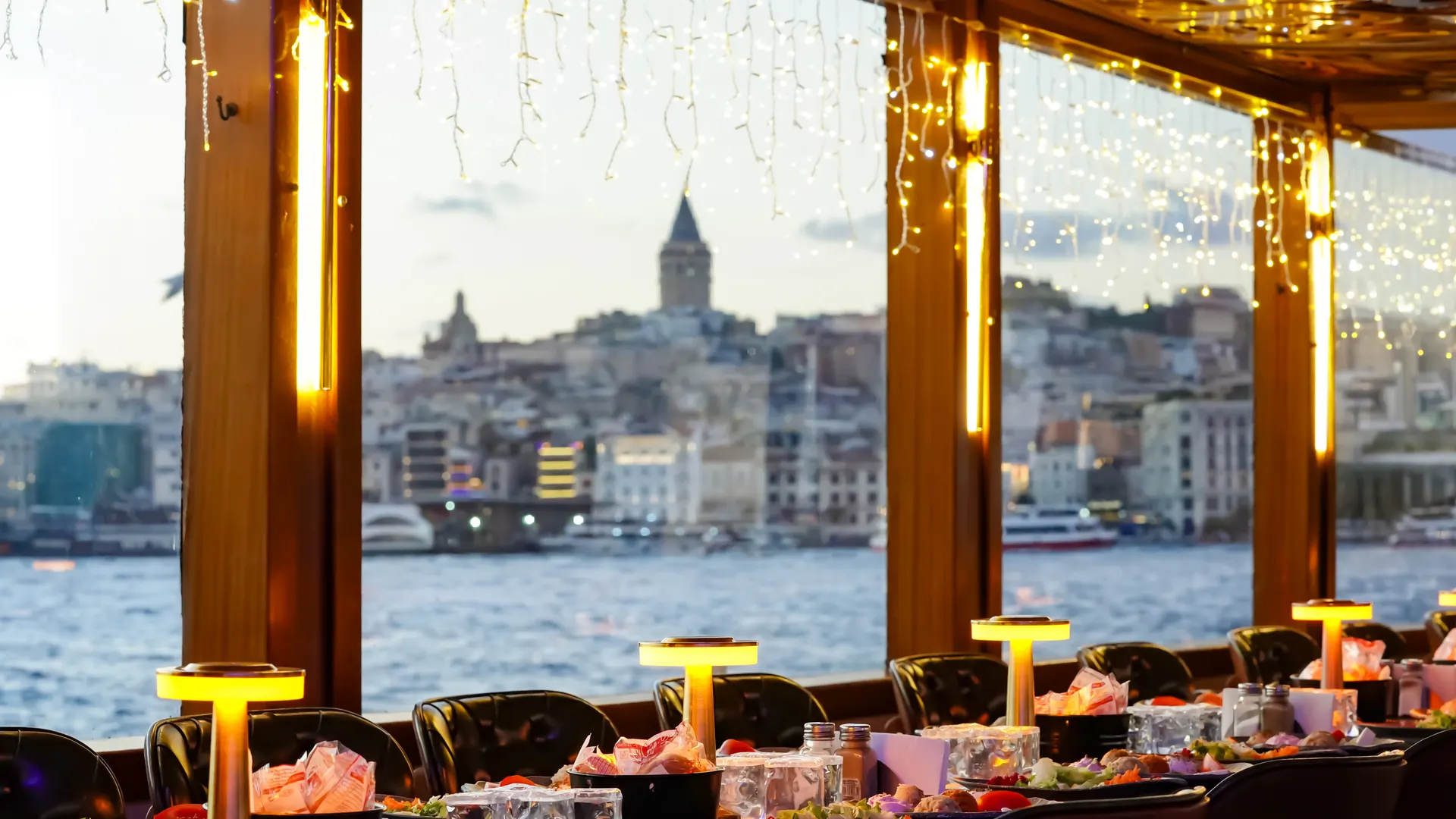
Istanbul is one of the easier global cities to travel in as a Muslim family. The kitchen practice is halal by default, mosques are everywhere, the call to prayer reaches almost every neighbourhood, and the cultural register — hospitality first, alcohol present but not central — sits naturally with how most Muslim families want to travel. This guide is written for the family that wants upscale comfort without compromise: the restaurant with the view, the hotel that quietly understands, the evening on the water that arrives at the table fully halal.
Turkey is halal by default
Most of the small worries a Muslim traveller carries elsewhere — was this stock prepared correctly, is there pork hidden in the menu, will the hotel breakfast contain bacon — simply do not apply here. Pork is almost absent from Turkish cuisine. Supermarket meat is processed under halal slaughter as standard. Restaurant kitchens, with rare exceptions in the international-fine-dining tier, source the same way. Mosques are within walking distance of any neighbourhood you might stay in, and the call to prayer is part of the city's soundtrack.
The few exceptions worth knowing: international hotel breakfast buffets may include pork sausages or bacon at a clearly labelled station; ask the staff and they will direct you to the halal-only line. A handful of European-style restaurants in Beyoğlu (think Italian delicatessens, French bistros) explicitly source non-halal — these are clearly recognisable from the menu and easily avoided.
Where to eat, by neighbourhood
Sultanahmet & the Old City
The Old City is the historic heart and the easiest district to dine in halal-default. Matbah, on the grounds of the Ottoman Imperial Hotel, serves court-cuisine dishes recovered from Topkapı archives — quince stew, lamb shank with figs — in a refined, unhurried room. Asitane, near the Chora Mosque, runs a similar academic kitchen with even longer-dated recipes. Deraliye, a short walk from the Blue Mosque, is the most accessible of the three: full Ottoman menu, family-suited, English-speaking staff. None serve pork; all serve alcohol on request only.
Beyoğlu & Galata
Beyoğlu's modern dining scene is mostly halal-default at the kitchen level, even where wine and cocktails are on the menu. Karaköy Lokantası is the obvious example — a beloved Turkish kitchen in a tiled room, serving the same braises and meze recipes Istanbul families cook at home, where alcohol is a side option rather than the main event. Mikla, on the rooftop of the Marmara Pera, is the city's flagship modern-Turkish kitchen; the meat program is halal-sourced and the chef is happy to confirm on request. For couples who want the view without the bar atmosphere, request a dinner-time table in the dining room rather than the rooftop terrace.
The Bosphorus shore
Tuğra at the Çırağan Palace is the high end — Ottoman fine dining inside a converted imperial hall, with the strait outside the window. Halal-sourced meats, alcohol on the menu but a la carte; the experience does not depend on it. For something casual and family-friendly, Sait Köfte in Bebek serves grilled kebab and meatballs in a no-fuss room. The Bebek waterfront strip is broadly accommodating — most kitchens are halal and most servers can guide a family through the menu.
The Asian side
Kadıköy is where many Istanbullus eat best on a normal night. Çiya Sofrası on Güneşli Bakkal Sokak is the city's most respected regional-Anatolian kitchen — fully alcohol-free, halal-default, and the most educational meal you will eat in Istanbul if you order the whole table of small plates. Kanaat Lokantası in Üsküdar, in business since 1933, is the equivalent for traditional home cooking; also alcohol-free, also halal. Both are easy with children.
Alcohol-free and halal-friendly hotels
Istanbul's halal-hotel category has matured. Two tiers are worth knowing.
Fully alcohol-free, halal-certified. The Bof Hotel Sultanahmet sits a short walk from the Blue Mosque, with a halal-certified kitchen, no alcohol on the premises and a quiet, family-oriented atmosphere. The Wome Deluxe group's Istanbul-affiliated properties operate on the same model — separate family floors, prayer mats in every room, no alcohol anywhere on site. These hotels do not have the marble lobbies of the major internationals, but they remove every small friction a Muslim family would otherwise have to manage.
International luxury — alcohol present, halal accommodated. The Çırağan Palace Kempinski and the Four Seasons at the Bosphorus both serve alcohol in their restaurants and bars, but both will provide a fully halal menu on request (most of their kitchens are already halal-sourced), can empty a mini bar on request, and offer private dining rooms for families who would rather avoid the bar floor. The Raffles Istanbul in Zorlu Center operates similarly. None of these will be marketed as halal hotels, but all are workable for families that want the international-luxury experience and are comfortable making a few requests at check-in.
Prayer logistics
The Diyanet (Turkish Directorate of Religious Affairs) publishes accurate, neighbourhood-specific prayer times. The free Diyanet app and the website at namazvakitleri.diyanet.gov.tr both work in English. The call to prayer (azan) is broadcast from every mosque in the city; in the older neighbourhoods, several mosques call simultaneously and the layered sound carries across rooftops — an experience worth standing still for, even once.
Finding a mosque is almost never the problem. The Old City, Üsküdar, Fatih and Eyüpsultan are wall-to-wall with them; even in modern districts like Şişli or Beşiktaş, a mosque is within five minutes' walk. Most have a dedicated women's section, ablution facilities and a small shoe-rack arrangement at the door.
Mosques worth visiting
For the Muslim traveller, the great mosques of Istanbul are working houses of worship as well as monuments. A few to plan around.
- Süleymaniye Mosque. Sinan's masterpiece, on the third hill of the Old City, with the strongest sense of Ottoman classical architecture in the city. The garden terrace at the rear gives a panoramic view across the Golden Horn — one of the great free views in Istanbul.
- Sultan Ahmed (Blue Mosque). The interior is back to full access after the 2018–2023 restoration. Six minarets, the famous Iznik tile work, and the largest open prayer floor in the Old City.
- Hagia Sophia. Restored to mosque function in 2020. Now serves the five daily prayers; non-prayer visiting hours are clearly posted at the entrance.
- Çamlıca Mosque. The newest of the great mosques, on the Asian-side hilltop. Modern Ottoman idiom, vast in scale, with the broadest panoramic view of the city from any mosque terrace.
- Yeni Cami. On the Golden Horn waterfront beside the Spice Bazaar, with the most photographed silhouette in Istanbul. Easier to visit than Sultanahmet, equally beautiful inside.
Maghrib prayer in summer falls between 20:00 and 20:45 depending on the month. If you are timing the cruise around it, the 21:00 departure works perfectly — pray before boarding (a small musalla is available near the Eminönü pier) and you arrive at dinner exactly as the bridges light up.
Mosque etiquette and dress
The expectations are gentle and clearly signposted. Shoulders and knees covered for everyone. Women cover their hair with a scarf; clean, loose scarves are provided free at every major mosque entrance, with attendants who will help if you've not worn one before. Shoes come off at the door and either go on the racks or, more commonly for visitors, into a small plastic bag carried with you. Phones on silent; photography is welcome outside prayer times in most mosques, discouraged in some — look for the small signs.
Avoid the five daily prayer times themselves. Each prayer takes about fifteen minutes; wait until the worshippers have left and the cleaning staff have re-set the prayer mats, then visit. Friday afternoon (Cuma) is the busiest prayer of the week and the most respectful time to keep your distance.
Family activities
Istanbul rewards families that mix the historic with the breathable. A few combinations that work.
The Princes' Islands — Büyükada in particular — make a perfect car-free day: a ferry across the Marmara, electric carts or rented bicycles around the island, lunch on a wooden terrace by the harbour, swimming in summer. İstanbul Akvaryum in Florya is the largest themed aquarium in Europe; a half-day with younger children, easily reachable from the airport hotel district. Miniatürk, on the Golden Horn, is a curated open-air park of miniature reproductions of Turkey's great monuments — educational, walkable, photogenic for the kids.
Inside Topkapı Palace, the Chamber of Sacred Relics is the quietest and most meaningful room for Muslim visitors — keeping the Prophet's mantle and other Islamic relics in a continuously-recited atmosphere. Children sense the gravity instinctively; it is a different register from the rest of the palace.
A halal Bosphorus evening
The dinner cruise we operate is built halal from the kitchen up. Every meat on the menu is from a halal-certified supplier, the kitchen has no pork or pork derivatives on the premises, and the standard service contains no alcohol. Alcohol is offered only as a separately requested add-on package; if you do not order it, no alcohol is brought to the table, and a family seated at one table is never asked about another table's drinks.
The menu is built for a Turkish family table — meze, soup, a grilled main of beef or chicken, dessert, fruit, Turkish coffee and tea. A simplified kids' menu is available; children 4–7 are 50% off and under-4 are free. The performance programme — Anatolian folk dances, the Mevlevi semâ, classical Turkish music — is culturally familiar and family-suitable. The dance floor opens after, but is optional; the upper deck and quiet window-side tables remain available throughout for families who prefer to watch.
Ramadan notes
The cruise's 21:00 departure works neatly around Ramadan timings. In summer Ramadan, iftar falls around 20:30–20:45 — there is time to break the fast at the hotel or at one of the iftar tents (the Sultanahmet square hosts a celebrated communal one) and arrive at the pier comfortably for boarding. A Ramadan-period iftar service can be arranged on board on request for the appropriate dates; mention it at booking.
In winter Ramadan, iftar falls around 17:30 and the cruise begins three hours later as a dinner-after-iftar experience — most guests treat it as the evening's second meal rather than the iftar itself.
The family table on the water
Halal-certified menu, alcohol-free by default, family seating, kids' pricing and a 21:00 departure that works around prayer and iftar timings. Tell us at booking if there's anything specific you'd like the kitchen to prepare.
Reserve Your Evening →