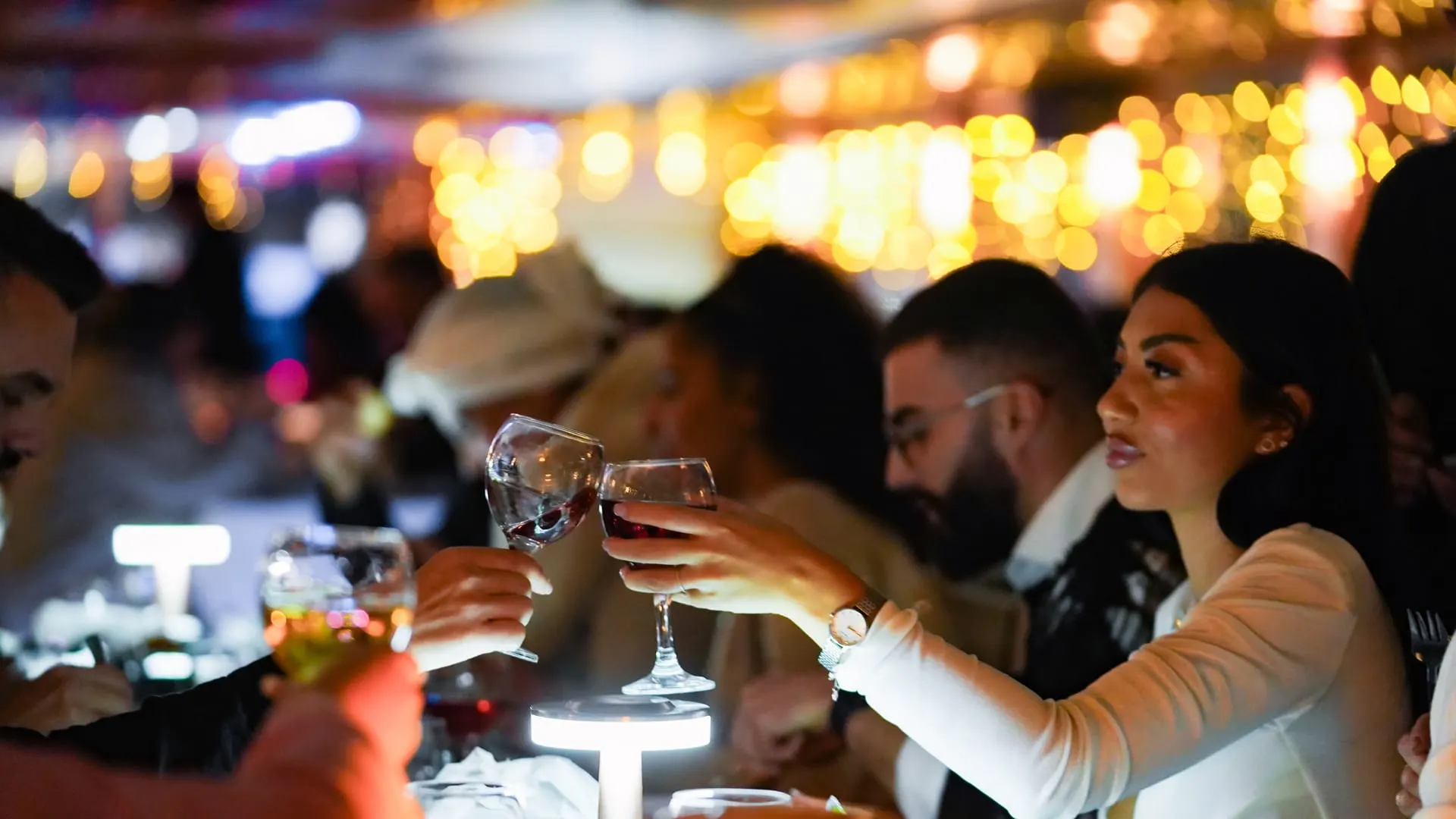
Of all the requests our team receives in advance of an evening, the most carefully worded — sometimes written and rewritten twice in the same email — are the ones from people planning to propose. They are nervous, and they should be: this is a real moment of a real life, and they would like it to go well. The good news is that the Bosphorus is, in our experience, an honest collaborator in this. The geography does most of the work. What follows is a small playbook drawn from the proposals we have quietly helped to stage over the past two seasons, written so that you arrive on the boat with a plan and can stop carrying the weight of it.
Why people propose on the Bosphorus
It comes down to three things, in our reading. The first is the geography itself — a narrow strait with the city standing up on both sides, two suspension bridges hanging above, and a strong sense, when the boat is mid-stream, of being held inside something larger than the everyday. The second is the moving frame: unlike a restaurant, the view is constantly composing itself anew behind whoever is sitting opposite you, so there is never the slightly stranded feeling that comes from a static room. The third is the light. After dark the European and Asian shores both light up — mosques, palaces, the bridges strung with cool white — and the water reflects all of it. It is one of the most flattering settings in the city for a photograph that you will keep.
None of this makes the question easier to ask. But the room around the question is on your side.
The two windows in the evening
Practically, there are two moments in a three-hour cruise that almost everyone choosing to propose has settled on.
The bridge approach, roughly twenty-five minutes after departure. The boat clears the pier at 21:00, swings north along the European shore past Dolmabahçe, and by around 21:25 is approaching the underside of the Bosphorus Bridge — the older of the two suspension bridges, lit at night with cool white running lights. The boat slows as it passes underneath. If you are on the upper deck, the bridge is directly overhead and the city is at its widest behind you. This is the moment most couples choose; it is dramatic, and the upper deck at that point is rarely crowded because dinner has just started downstairs.
The Ortaköy return, around one hour and ten minutes in. After turning at the FSM Bridge, the boat comes back down past Ortaköy Mosque — small, white, baroque, perfectly framed against the Bosphorus Bridge behind it. By this point dessert is on the table and the deck has thinned out again. This is the slower, more reflective option, and the better one for proposers who would rather be sitting than standing.
Either works. Pick the one that suits the person you are asking.
Reserving the right table
Tell us at the time of booking. The single most important detail is a window-side two-person table in the main salon — not a four-person shared with strangers, not a corner near the kitchen. Our team holds a small number of these for couples specifically; mentioning a proposal at the booking stage moves your reservation onto that list. It is the difference between an evening that quietly orients itself around you and one that does not.
If you prefer the upper deck for the moment itself, we still reserve a window-side table for dinner and walk you upstairs at the chosen time. The table waits.
The romantic-table add-on
An optional setup that costs a little extra and changes the room around your seat. The components: a pair of slim candles in glass, a scatter of fresh rose petals on the linen, a small low floral arrangement (white, ivory, or soft pink depending on availability), and the table dressed in a darker overcloth so the candles read against it. On request, we can tuck a small printed note inside the menu — a single line, anything you write — or place a small framed card on the table when you sit down. Nothing on a microphone. Nothing on a screen. The point is that the room is a degree quieter, a degree warmer, a degree more clearly meant for the two of you.
The setup is done while you are on the upper deck before the meal, so the table is ready when you come down. The staff who handle it have done it many times; they are quiet about it.
On-board photographer
Arranged in advance, on request. The brief we give the photographer is, in this order: invisibility, the moment itself, then a short set of couple portraits afterwards. Invisibility because the worst version of a proposal photograph is one where the proposer is visibly aware of the camera. We position the photographer behind a pillar or at the edge of the salon, lens long enough to keep distance. The moment itself — the question, the answer, the embrace — is captured from there. Afterwards, with both of you now in on it, we move to the upper deck for ten or fifteen minutes of proper portraits against the lit bridges and the water.
The set is delivered to your email within two to three working days. Couples who plan to share it widely sometimes prefer to wait and curate; that is fine, the files are yours.
Ring logistics
The unromantic but useful bit. A few things we have learned.
Keep the ring in an inside jacket pocket with a flap, not a trouser pocket where it bulks visibly when you sit down. If you do not wear a jacket, a small zippered crossbody is fine and unsuspicious. As a backup, the maître d' can hold the ring in a sealed envelope in the office safe until the moment is approaching and bring it discreetly to the table. Several proposers have used this; it removes the entire category of pocket anxiety from the evening. Tell us at booking if you want this option.
Do not — and we have seen this — try to balance the ring on a dessert spoon or float it in a champagne flute. Both are good ways for a ring to end up in the Bosphorus. The strait is two hundred metres deep in places. The ring does not come back.
Walk the route once in your head before you board. Know where the table is, where the upper-deck stairs are, and which side of the boat the bridge will pass on (the right, going north). Five minutes of mental rehearsal saves the moment from feeling improvised. Then forget the rehearsal and look at the person you came with.
Weather backup
Istanbul evenings cooperate most of the time, but they do not always. In rain, strong wind, or cold weather, the upper deck is closed for safety. This is a real possibility from late October to early April, and an occasional one in shoulder season. The contingency is built in.
The main salon has full panoramic windows along both sides. A window-side table at the bridge approach gives you, essentially, the same view through glass — the bridge passes directly overhead and the lights of the city stretch out on both shores. Many couples who originally planned an upper-deck moment have proposed at the window seat with the bridge sliding past and afterwards said they preferred it: warmer, quieter, more contained.
If the weather is severe, the photographer comes to the table rather than the deck. The portraits afterwards happen at the window. The evening still works.
What we don't do
A clarification that matters. We do not announce proposals on the boat's microphone. We do not project names or messages on a screen. We do not orchestrate applause, or have the band stop and turn. We do not gather other guests around the table.
What we do is set the room, hold the table, brief one or two members of staff who need to know, and then step back. The moment is between two people. The staff's job is to disappear into the evening so completely that, looking back, you would struggle to remember whether they were there at all.
A window-side table, quietly arranged
Mention the occasion when you book. Window seats, the romantic-table add-on, an on-board photographer on request. Free cancellation up to two hours before. Pay on the boat.
Reserve Your Evening →